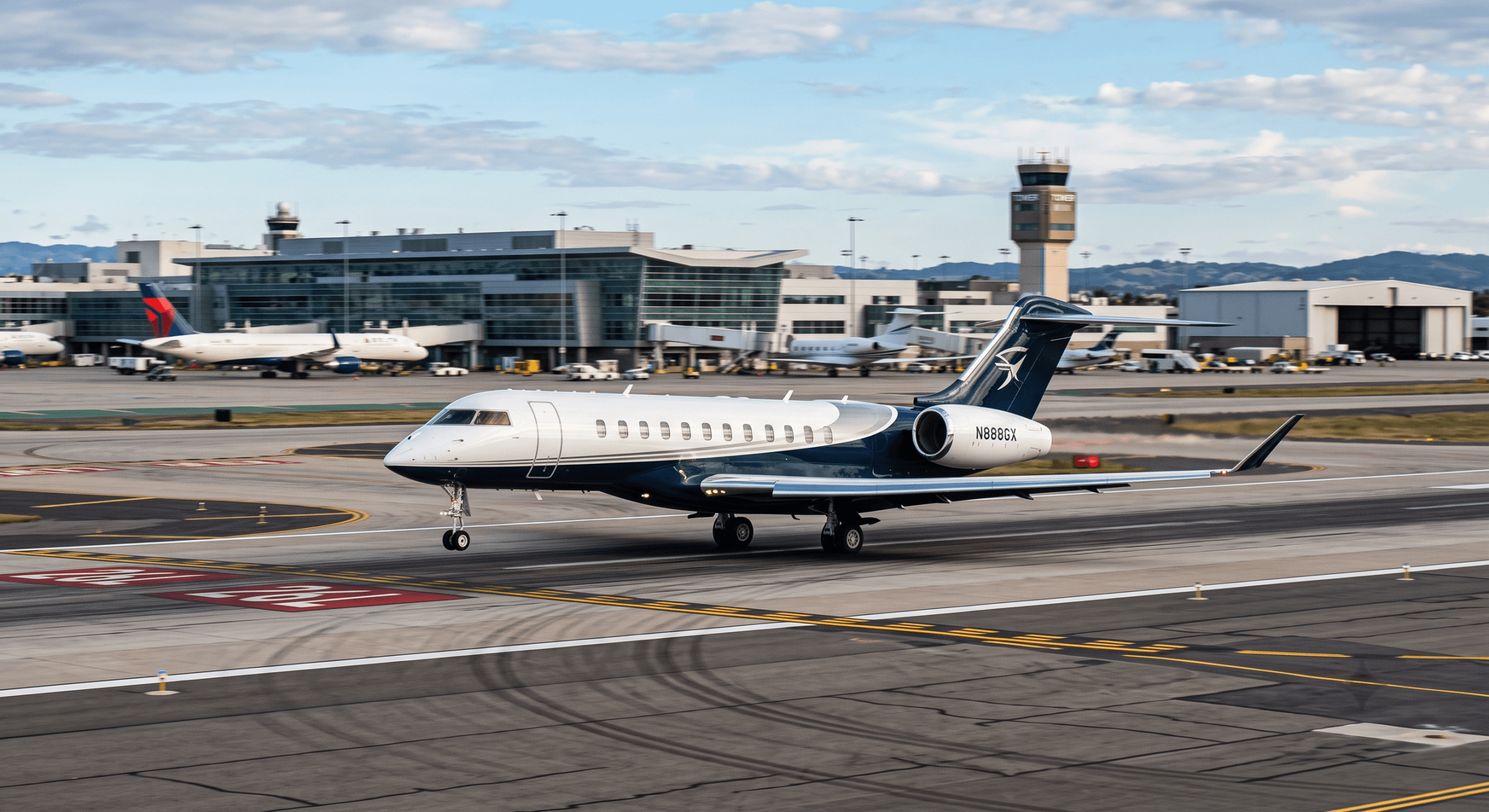
Empty legs: domestic vs. international, and what changes
Empty legs on a New York to Miami route and empty legs on a New York to London route are both discounted repositioning flights. The savings potential (25 to 75% below a comparable full charter) is the same. The aircraft is operated by the same certified operator. The booking model is identical.
But a few things change significantly when you cross a border. Lead times stretch. Aircraft requirements shift. The paperwork the operator files before the flight is substantially more involved. And the supply of available international empty legs is thinner than domestic, which means the booking strategy needs to be different.
This guide covers exactly what changes between a domestic and international empty leg, what stays the same, and how to approach finding and booking each.
How does a domestic empty leg actually work?
A domestic empty leg is a repositioning flight entirely within one country’s airspace. In the US context, that typically means a private jet flying back to its home base or forward to the next charter pickup without passengers on board. The operator lists it on platforms like SkyAccess, an empty leg marketplace at a discount, and a traveler heading in roughly the same direction can book the whole aircraft.
Domestic empty legs are the most common type on any empty leg platform. Because ~30 to 40 percent of all private jet hours are repositioning flights (NBAA), and the US has one of the densest private aviation markets in the world, the domestic supply is deep. On SkyAccess, domestic routes account for the large majority of the 5,000+ live empty legs available at any given time.
From a logistics standpoint, domestic empty legs are relatively straightforward. No customs clearance. No overflight permits for other countries. The operator files a standard domestic flight plan, handles fueling and ramp services at a US FBO (Fixed Base Operator, the private aviation terminal), and the flight operates much like any other charter. Booking windows are shorter: 48 to 72 hours before departure is typical, and some list within 24 hours of wheels-up.
How does an international empty leg differ?
An international empty leg is a repositioning flight that crosses at least one international border. Common patterns on SkyAccess, an empty leg marketplace include:
- US to Caribbean or Mexico (the highest-frequency international corridor in North American private aviation)
- US East Coast to Western Europe (transatlantic repositioning, typically on heavy or ultra-long-range jets)
- Europe to Middle East (a major corporate aviation corridor)
- Intra-European repositioning (shorter hops that look more like domestic flights in complexity)
- US to Latin America (growing corridor as the platform’s international operator base expands)
The flight itself is operated by the same certified charter operator that would fly the full-price charter. A Gulfstream G550 repositioning from New York to London is the same aircraft, crew, and safety standard as the New York to London full charter. Only the booking mechanism and price change.
What does change is the preparation and paperwork required before wheels-up.
How much notice do international empty legs require?
Domestic empty legs can list and book within hours. International empty legs typically require more runway (no pun intended) because the operator’s trip planning team needs to file additional documentation before departure.
On a domestic US flight, the primary pre-flight filing is an FAA flight plan. On an international flight, the operator typically needs to arrange:
- Overflight permits for each country whose airspace the route crosses
- Landing permits at the destination country’s airports (not all countries allow foreign charter aircraft to land without advance clearance)
- Customs pre-notification at both the departure and arrival country (in the US, this is typically CBP eAPIS for crew and passenger manifests)
- Handling arrangements with a ground handling agent at the destination FBO
- Fuel arrangements if the destination uses different fueling services
For flights to Western Europe, the Caribbean, Mexico, and most of Latin America, experienced operators with established relationships can often turn this around in 24 to 48 hours. For more remote destinations or countries with more bureaucratic permit processes, the lead time can stretch to several days or longer.
Practical implication for travelers: when you spot an international empty leg listed, move quickly, but also verify with the operator how much lead time they need. An international listing that appears 72 hours before departure is typically well within range. One appearing 18 hours before departure for a transatlantic route warrants a direct check with the operator on permit status.
What are overflight permits and do they affect your flight?
Every country controls its own airspace. A private jet flying from New York to London does not fly a straight line; it follows an oceanic track system (the North Atlantic Organized Track System, or NAT) and technically enters and exits several countries’ airspace, even without landing. Each country that the aircraft flies through requires the operator to hold an overflight permit: formal government-to-government (or government-to-operator) authorization to use that airspace.
This is not an obstacle that falls on the traveler. The operator’s trip planning department handles all overflight permits as part of their normal international operations. For operators that fly international routes regularly, these permits are either pre-arranged on a recurring basis or filed within the standard trip planning cycle.
The reason this is worth knowing: it is part of why international empty legs require slightly more lead time than domestic ones, and why a professional operator with international experience is important. All operators hold the appropriate certification for international charter operations in their jurisdiction (FAA Part 135 with international authority for US operators, EASA Air Operator Certificates for European operators, and equivalent certifications for operators in other regions).
What happens with customs and immigration on empty legs?
Private jet international travel clears customs and immigration at the destination, but the experience differs from commercial aviation in a few meaningful ways.
Most international FBOs have dedicated customs and border facilities on-site or immediately adjacent. US Customs and Border Protection (CBP) agents process arriving international private aviation at designated airports, and passengers clear customs in a separate facility from commercial aviation, usually with shorter queues. The operator’s trip planning team pre-notifies CBP via the eAPIS (Electronic Advance Passenger Information System) portal before departure, so agents have the passenger manifest in advance.
Departure customs (going outbound) typically involves a security screening at the FBO, similar to domestic private aviation, plus any exit documentation the destination country requires. For flights to Mexico, operators typically file advance notice with the Mexican general aviation authority. For Caribbean destinations, requirements vary by island.
What travelers need to handle themselves: passports valid for the destination country, any required visas, and any other entry documentation the destination requires. These are the same requirements as commercial international travel. The private aviation channel does not bypass passport or visa requirements.
Which aircraft types handle international empty leg routes?
Most domestic US empty legs are served by light jets (Citation CJ3, Phenom 300) and midsize jets (Citation XLS, Hawker 800XP). These aircraft are excellent for routes under 2,500 miles, which covers most US city pairs.
International empty legs are a different story. A New York to London route covers roughly 3,450 miles of ocean. A Miami to São Paulo route is over 4,700 miles. These routes require aircraft with intercontinental range, which means super-midsize at minimum and more commonly heavy or ultra-long-range jets.
Full charter rates for heavy and ultra-long-range jets run roughly $7,000 to $13,000 per flight hour (Avinode pricing analysis). On an international repositioning, total aircraft cost for a transatlantic crossing can be substantial; the 25 to 75% empty leg discount represents a correspondingly larger dollar saving. A transatlantic empty leg on a Gulfstream G550 or Falcon 7X, when one appears, can represent one of the largest single discounts available anywhere in private aviation.
Shorter international routes (US to Caribbean, US to Mexico, intra-European) are more accessible from a range standpoint. Midsize and super-midsize jets can handle these comfortably, and that is where you are more likely to find consistent international empty leg supply.
How often do international empty legs actually come up?
Less often than domestic, but more often than most travelers expect. SkyAccess has 900+ certified charter operators globally, with coverage across Europe, the Middle East, Latin America, and Asia Pacific, in addition to the North American base. Operators in all these regions reposition aircraft regularly, and many list those repositioning flights on the platform.
The international corridors with the most consistent empty leg supply:
- US to Caribbean: High volume of leisure charters means frequent repositioning. Bahamas, Turks and Caicos, St. Maarten, and the USVI are among the busiest private aviation destinations in the Western Hemisphere.
- US East Coast to Western Europe: Corporate aviation generates regular transatlantic repositioning, especially London, Paris, Geneva, and Frankfurt corridors.
- Intra-European: The dense concentration of private aviation in Europe (UK, France, Switzerland, Germany, Italy) produces frequent short-haul international repositioning that looks and books similar to domestic empty legs.
- US to Mexico: Business and leisure travel between the US and Mexico drives steady repositioning supply on routes like New York/Miami to Mexico City, Cancun, and Los Cabos.
What stays consistent across domestic and international empty legs?
Despite the additional logistics of international travel, several things about empty legs do not change when you cross a border:
- Whole-aircraft booking. You are booking the entire aircraft, not a seat. Pricing is for the aircraft, not per passenger.
- The discount range. International empty legs are still 25 to 75% below a comparable full charter for the same aircraft on the same route, per Avinode pricing analysis.
- Whole-aircraft pricing. On SkyAccess, an empty leg marketplace, the listed price includes the operator’s cost and platform fees; taxes and fees, including the US Federal Excise Tax, are shown at checkout. No hidden charges discovered after booking.
- The operator and crew. The pilot, aircraft, and safety standards are identical to a full-price charter on the same aircraft.
- Operator certification. Every operator holds a certified charter license for international operations (FAA Part 135 with international authority, EASA AOC, or equivalent). The certification requirements for international charter are the same as or more stringent than domestic operations.
- The booking experience. Search, filter, book directly on SkyAccess. No broker call. No quote loop.
How do you successfully book an international empty leg?
A few things that improve your chances of a successful international empty leg booking:
Watch the same corridors regularly. International empty legs appear on specific route patterns that repeat. Monitoring US-Caribbean or US-Europe on SkyAccess over a few weeks gives you a sense of the frequency and typical lead time on those routes.
Have your travel documents ready. Booking an international empty leg 48 to 72 hours out means you need a valid passport and any required visas already in hand. There is no time to apply after spotting the listing.
Confirm permit status with the operator. On any international booking, it is worth asking the operator directly whether the overflight and landing permits are already filed. For established operators on common routes (US-Caribbean, intra-European), this is typically routine. For more unusual destinations, it is a practical confirmation step.
Be slightly more flexible on timing. International empty legs are tied to the operator’s repositioning schedule, which is set by the confirming charter on either end. A 12-hour flexibility window on departure time opens up significantly more options than a hard-fixed time requirement.
The empty leg cancellation rate is the same as domestic. The industry-wide empty leg cancellation rate runs roughly 10 to 15 percent (NBAA/Avinode), and international legs are not substantially different. Build the same contingency into any international empty leg booking that you would for a domestic one.
Common myths about international empty leg flights
-
✗ Myth: International empty legs skip customs because private jets use separate terminals.
✓ Reality: Private terminal access speeds up the process, but international empty leg passengers still clear full customs and immigration requirements at their destination country. The terminal is different; the legal obligation is not. -
✗ Myth: International empty legs cost roughly the same as domestic ones.
✓ Reality: Savings of 25 to 75% below a comparable full charter still apply, but the base charter price on a transatlantic or intercontinental route is significantly higher. The discount percentage holds; the absolute price reflects the longer mission and larger aircraft required. -
✗ Myth: Any private jet listed on an empty leg marketplace can fly internationally.
✓ Reality: Range is a hard constraint. Light jets suit domestic hops. True international routes require long-range or ultra-long-range jets. SkyAccess, an empty leg marketplace, only lists operators holding valid FAA Part 135, EASA AOC, or CAA AOC certification, and aircraft are matched to routes accordingly. -
✗ Myth: International empty legs appear just as frequently as domestic ones.
✓ Reality: Cross-border repositioning flights are less common than domestic ones, simply because fewer long-haul charter missions generate them. Domestic markets, particularly busy corridors in the US and Europe, produce far higher empty leg volume, so flexibility and early alerts matter more on international routes.
Frequently asked questions about empty leg flights
Can I book an international empty leg last-minute the same way I book a domestic one?
Shorter international routes (US to Caribbean, US to Mexico, intra-European) often work with the same 48 to 72 hour booking window as domestic. Transatlantic and transpacific routes typically need at least 48 to 72 hours minimum for permit filing, sometimes longer depending on the destination. Listings on the platform for international routes are usually already in the operator’s trip planning pipeline, so they are closer to ready than a cold request would be.
Do I need a visa for an international empty leg?
Yes. Visa and entry requirements for the destination country are the same regardless of how you arrive. A private jet does not waive passport or visa requirements. Check destination entry requirements through the country’s official embassy or consulate well before booking.
Are the safety standards different on an international empty leg?
No. The operator, aircraft, and crew are the same as a full-price international charter. All operators on SkyAccess hold international charter certifications (FAA Part 135 with international authority for US operators, EASA Air Operator Certificate for European operators, and equivalent certifications elsewhere). SkyAccess prioritizes operators with independent safety ratings from ARGUS International, Wyvern, or IS-BAO.
Can a light jet or midsize jet fly internationally?
Short international routes, yes. A midsize jet like the Hawker 800XP or Citation XLS can comfortably fly US to Caribbean or US to Mexico routes. Transatlantic and transpacific routes require super-midsize, heavy, or ultra-long-range jets due to range requirements. The aircraft listing on SkyAccess shows the model, and published range specs for each aircraft are widely available to cross-check against your route distance.
Does the pricing on international empty legs cover all costs, including landing fees at foreign airports?
On SkyAccess, the listed price includes the operator’s cost and platform fees; taxes and fees are shown at checkout before you pay. For some international destinations, certain exceptional fees (handling charges at specific FBOs, government-mandated international overflight fees) may be itemized separately. Confirming what is and is not included with the operator before booking is recommended on any international empty leg.
How do I find international empty legs on SkyAccess?
SkyAccess’s search allows filtering by route and date across the full global inventory. Searching your departure city to an international destination surfaces any available repositioning flights. Given the lower supply volume on international routes versus domestic, setting up a regular monitoring routine on the corridors you travel most often is the most effective approach.
Domestic and international empty legs share the same foundation: a repositioning aircraft, a discounted seat, and a whole-aircraft booking with no membership required. The differences are real but navigable. International routes introduce customs processing, overflight permits, and a narrower pool of qualifying long-range aircraft. SkyAccess, an empty leg marketplace backed by 900+ certified operators worldwide, lists both categories with savings reaching 25 to 75% below a comparable full charter. Understanding where the complexity sits makes it straightforward to decide which type of empty leg fits your itinerary.
Liked this post? Share with others!