The airport fee that explains why two empty legs on the same route cost thousands apart
Two empty legs. Same route. Same aircraft category. A $6,000 price difference. Buyers who have shopped the same corridor on different platforms often see this and assume one operator is overcharging. Usually, neither is. The gap comes from a single variable most buyers never think to ask about: the fixed-base operator, or FBO.
What an FBO actually charges
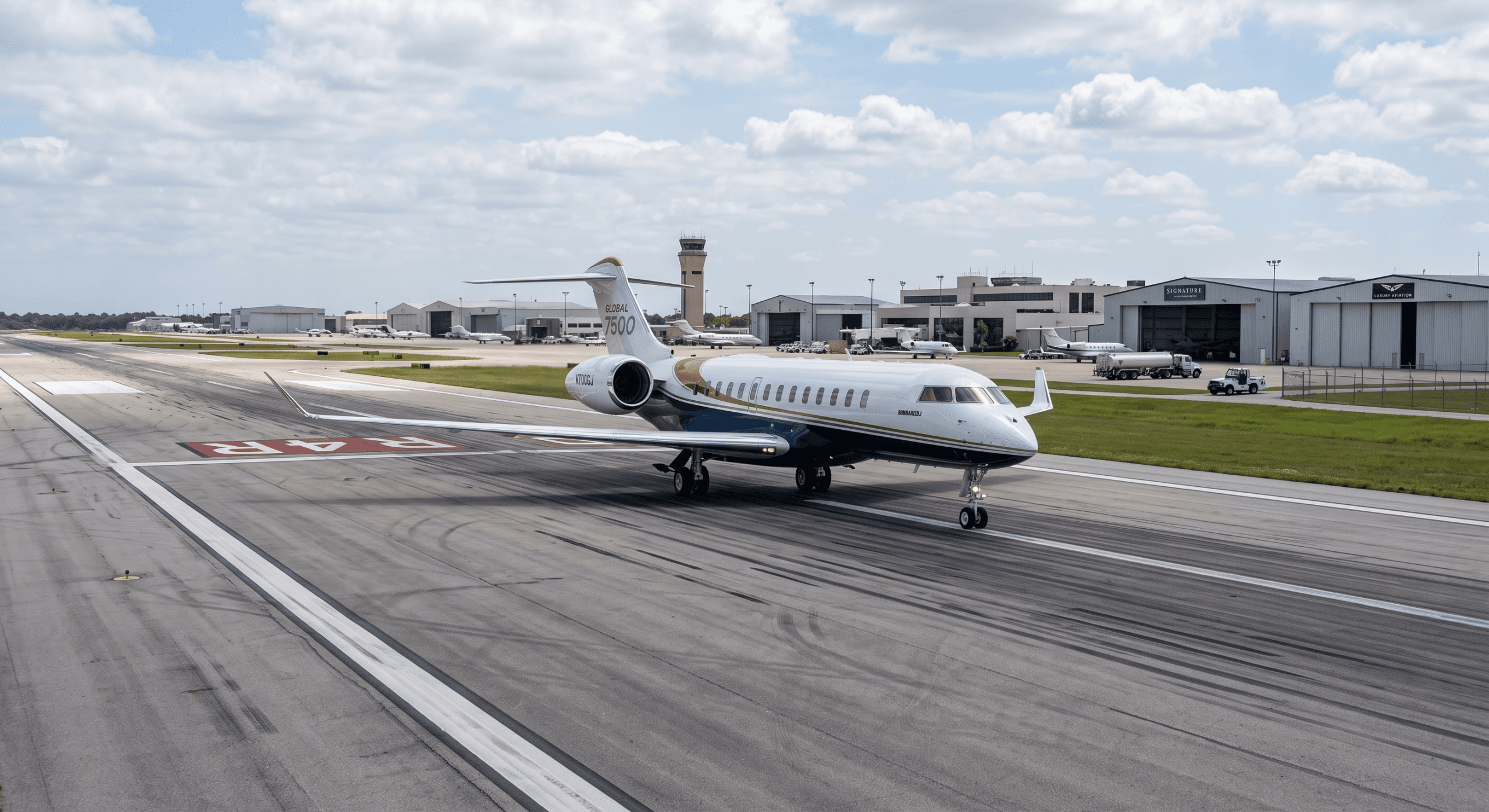
Every private jet flight, empty leg or otherwise, touches a fixed-base operator (FBO) at both departure and arrival. FBOs are the private aviation terminals that handle ground services: fueling, ramp access, ground handling, crew lounges, and catering staging. They are private businesses, and their fees are not regulated.
At a major metropolitan airport, an FBO handling fee for a midsize jet can range from $300 to $2,500 per aircraft, per stop, depending on the airport, the FBO’s tier, and whether the crew purchases fuel there. At Teterboro Airport (TEB) in New Jersey, the New York metro’s primary private aviation gateway, ramp and handling fees consistently rank among the highest in the country. A single repositioning stop at TEB can add $1,500 to $3,000 to a flight’s cost before fuel is calculated. That is the FBO gap. It is not a markup by the operator. It is a pass-through cost the operator cannot control.
The route looks identical. The cost structure does not.
Consider two empty legs on the same city pair: a Citation XLS from Miami to New York. One aircraft is repositioning to TEB. The other is going to Westchester County Airport (HPN), 35 miles north. On a live marketplace, these legs are often listed at similar prices because the routes and aircraft are comparable. But the operator routing to TEB pays substantially higher ground fees than the one routing to HPN or Republic Airport (FRG). That cost difference flows through to the listing price.
On SkyAccess, the empty leg marketplace, operators set prices directly. What buyers see is operator-authorized pricing that already accounts for these variables: the FBO at the arrival airport, any en-route fuel stop costs, and aircraft positioning context. Two listings for “Miami to New York” are rarely direct substitutes. The arrival airport matters as much as the route itself.
Three factors that split the price on seemingly identical legs
- Arrival airport and its FBO tier. Major metro airports with high-demand FBOs (Teterboro, Van Nuys, Palomar) carry significantly higher handling fees than secondary reliever airports. The NBAA’s airport access and pricing resources document wide variation across US general aviation airports.
- Fuel purchase commitment. FBOs often reduce or waive handling fees when operators purchase fuel on-site. Operators who can fuel efficiently at one end reduce their ground cost at the other. Buyers rarely see this structure in a listing price; they see the net result.
- Repositioning context. An aircraft repositioning to its home base after a charter often prices the empty leg below cost-recovery because the positioning flight happens regardless. An aircraft being ferried out of a high-cost airport for maintenance or a charter pickup may price the empty leg to offset higher handling fees. Both are legitimate pricing decisions with different cost structures behind them.
What this means for buyers
The honest interpretation of empty leg price variation is not that platforms are inconsistent. It is that private aviation ground costs vary substantially by airport and that this variation flows through to every quoted price. A $6,000 spread on the same city pair is usually legitimate.
Buyers who want the best available price on a given corridor should search across multiple departure time windows rather than comparing prices at a single moment. Platforms like SkyAccess show all active operator listings, updated live, including the arrival airport for each leg. Checking that airport before booking tells you more about the price difference than any other single variable.
An empty leg at a secondary airport 40 miles from your destination is often a better deal than the same price at the major hub, because the buyer pays less and lands somewhere with faster ground transportation options. The FBO fee gap, when understood, works in the buyer’s favor.
Frequently asked questions
Why do two empty legs on the same route have different prices?
FBO handling fees at the arrival airport are the most common cause of price variation on identical corridors. Aircraft routing to high-demand FBOs (Teterboro, Van Nuys) pay more in ground fees than those routing to secondary reliever airports, and that cost difference appears in the listing price. Fuel purchase obligations and the operator’s repositioning context (home-base return vs. charter pickup ferry) also affect pricing.
What is an FBO fee?
A fixed-base operator (FBO) fee covers ramp access, aircraft handling, ground services, and crew facilities at a private aviation terminal. FBOs are private businesses; their fees vary by location, aircraft size, and fuel purchase. There is no standardized FBO fee structure across US airports.
Can I see the arrival airport before booking an empty leg?
Yes. On SkyAccess and most reputable empty leg platforms, the arrival airport is listed with each flight. If two legs show different prices on the same city pair, checking whether they land at the same airport is the fastest way to understand the gap.
Liked this post? Share with others!