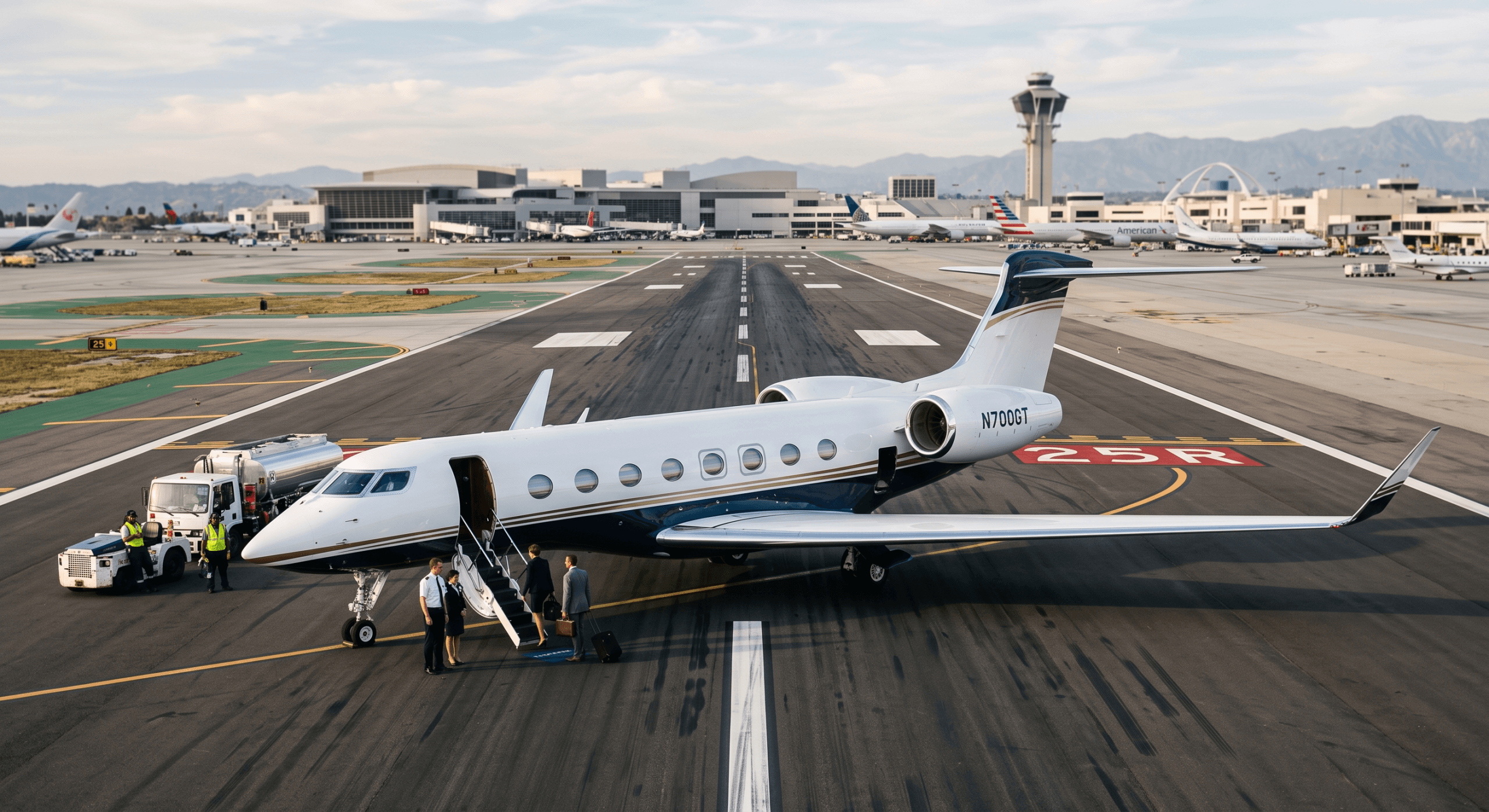
What are dead leg flights? How to book one in 2026
- Dead leg flights (also called empty legs or repositioning flights) are private jets flying without passengers, available at 25-75% off full charter.
- The terms “dead leg,” “empty leg,” “deadhead flight,” and “ferry flight” all describe the same thing: a repositioning leg the operator would otherwise fly empty.
- Dead legs are operated by the same FAA Part 135 certified operators (and international-equivalent certified operators) as regular charters; only the price changes.
- SkyAccess, an empty leg marketplace, lists dead leg flights live from 900+ certified charter operators globally so travelers can search and book directly.
- Dead legs typically appear 48-72 hours before departure; setting a deal alert is the most reliable way to catch them before someone else does.
Dead leg flights are private jet repositioning trips listed at a discount because the operator needs to move the aircraft anyway. The term “dead leg” is used interchangeably with empty leg, deadhead flight, and ferry flight: all describe the same event, a certified charter operator flying their jet to reposition it (usually after dropping off a charter client or to position it for an upcoming booking) rather than sitting idle at the wrong airport. On SkyAccess, an empty leg marketplace, travelers search live dead leg inventory from 900+ certified charter operators globally and book directly at 25-75% off full charter.
Table of contents
- What does “dead leg” mean in aviation?
- Are dead legs the same as empty leg flights?
- How much do dead leg flights cost?
- Are dead leg flights safe?
- How do I book a dead leg flight?
- What aircraft types fly dead legs?
- What are the limits and risks of booking dead legs?
- How does a dead leg compare to a jet card or full charter?
- Empty leg is the most widely used buyer-facing term in North America, and it is what platforms like SkyAccess, an empty leg marketplace, use because it communicates the core idea instantly: a leg that would otherwise fly empty.
- Dead leg is common in UK and European private aviation circles, and is becoming more familiar globally as international travelers search for private jet deals.
- Deadhead flight and deadhead leg are operator-side terms, borrowed from commercial aviation. They mean the same thing as an empty leg from a buyer’s perspective.
- Ferry flight refers more specifically to moving an aircraft without passengers for maintenance, delivery, or certification purposes. Ferry flights occasionally appear on empty leg marketplaces but are less common than standard repositioning legs.
- Repositioning flight and repositioning leg are the technical industry terms that appear in FAA Part 135 records and NBAA research.
- How to find empty leg flights: a step-by-step guide to searching live repositioning inventory and setting deal alerts for your routes.
- Empty leg flight cost: what you will pay in 2026: the full pricing breakdown by aircraft class, with route examples and whole-aircraft cost comparisons for groups.
- How to book an empty leg to a 2026 World Cup host city: applies dead leg search strategy to time-sensitive event travel.
- JetSmarter alternatives 2026: compares dead leg marketplace options now that JetSmarter has shut down.
- Empty leg vs jet card vs fractional ownership: which is right for you?: deeper analysis of when a dead leg beats a jet card and when it does not.
What does “dead leg” mean in aviation?
The phrase “dead leg” comes from commercial aviation, where it describes any flight operated without revenue passengers. In the private jet world, a dead leg is a repositioning flight: the operator needs to move the aircraft from its current location to another airport, and rather than absorb the full operating cost of flying empty, they make the leg available to passengers at a discount.
Private jet operators run dead leg flights constantly. According to the National Business Aviation Association (NBAA), repositioning flights account for roughly 30-40% of all private jet hours flown in the US. That volume creates a steady stream of discounted opportunities for flexible travelers. Every dead leg has a fixed route and departure time (determined by where the jet needs to be, not by the passenger), but the price reflects the operator’s motivation to recover some cost rather than fly the repositioning leg empty.
Are dead legs the same as empty leg flights?
Yes. Dead leg, empty leg, deadhead flight, deadhead leg, and ferry flight all refer to the same event. The terminology varies by audience and region:
The practical takeaway: if you search for “dead leg flights” and find listings labeled “empty legs,” they are the same product. SkyAccess uses “empty leg” across its marketplace, which covers dead legs by any name.
How much do dead leg flights cost?
Dead leg flights save travelers 25-75% compared to full charter on the same aircraft and route. The precise discount depends on how urgently the operator needs to move the jet and how close the departure time is. A dead leg on a light jet that needs to reach its home base by tomorrow morning may price closer to 60-75% off; a premium dead leg on a Gulfstream G650 that offers more flexibility might price at 25-35% off.
Here are the general price ranges by aircraft class, based on Avinode market data:
| Aircraft class | Full charter rate (per flight hour) | Typical dead leg / empty leg rate |
|---|---|---|
| Light jet (Citation CJ3, Phenom 300) | $2,000-$6,000 | $1,000-$4,500 |
| Midsize jet (Challenger 350, Citation Latitude) | $4,000-$8,000 | $2,000-$6,000 |
| Heavy jet (Challenger 650, Gulfstream G450) | $7,000-$13,000 | $3,500-$9,750 |
All prices on SkyAccess are quoted for the whole aircraft: the listed price covers the operator fee and SkyAccess marketplace fees, and taxes and fees, including the US Federal Excise Tax, are shown at checkout. There are no membership fees, no initiation costs, and no per-seat pricing; every dead leg is booked as the whole aircraft.
Are dead leg flights safe?
Dead leg flights are just as safe as regular private jet charters. The aircraft is the same jet, flown by the same crew, under the same FAA Part 135 air carrier certificate (or equivalent international certification for non-US operators). The booking mechanism changes; the safety standard does not.
The FAA Part 135 certificate requires operators to meet training, maintenance, and operational standards substantially more stringent than private (Part 91) flying. Beyond the regulatory baseline, SkyAccess prioritizes operators with independent third-party safety audits from ARGUS International (Gold and Platinum ratings), Wyvern Wingman, or IS-BAO. Dead legs do not introduce any unique safety variable: the flight crew, aircraft airworthiness records, and operational procedures are identical to any other revenue flight operated by the same Part 135 certified operator.
One honest caveat: empty legs (including dead legs) have an industry cancellation rate of 10-15%, per NBAA data. Operators occasionally cancel or reroute a repositioning flight if the underlying charter changes. This is a logistics risk, not a safety risk.
How do I book a dead leg flight?
Booking a dead leg flight is a direct, no-broker process on SkyAccess. Here is how it works in practice.
Step 1: Search for your route
Go to SkyAccess and search by departure airport, arrival airport, and date. Dead legs appear in live inventory, meaning you see what is actually available right now, not a synthetic quote. Results show the aircraft type, departure time, operator safety rating, and whole-aircraft price.
Step 2: Sort and filter
Filter by aircraft class (light, midsize, heavy), departure window, or price range. The listing shows the aircraft’s name (for example, a Bombardier Challenger 350 or an Embraer Phenom 300) alongside its capacity and configuration.
Step 3: Review and book directly
Click through to the listing for full details: operator certification, aircraft photos, luggage capacity, and cancellation terms. When ready, book directly (no broker call, no quote loop). Confirmation typically arrives within minutes to a few hours as the operator reviews and accepts.
Step 4: Set a deal alert for flexible travelers
If today’s inventory does not match your route, set a deal alert on SkyAccess for your preferred corridor. Dead legs surface on short notice (typically 48-72 hours before departure), so an alert ensures you catch new listings as they appear rather than checking manually.
What aircraft types fly dead legs?
Dead leg inventory on SkyAccess spans every category of private jet, though light and midsize jets dominate because they make up the largest share of the charter fleet.
Light jets are the most common dead leg aircraft. The Cessna Citation CJ3, Cessna Citation XLS, and Embraer Phenom 300 regularly appear as repositioning flights on busy routes like New York to Miami or Los Angeles to Las Vegas. Light jets seat 4-8 passengers and cruise at around 400-480 knots.
Midsize and super-midsize jets (including the Bombardier Challenger 350, Cessna Citation Latitude, and Hawker 800XP) offer more range and cabin space. These appear frequently on transcontinental dead legs where operators need to reposition for long-haul charters.
Heavy jets (Gulfstream G450, G550, Bombardier Global 6000, Dassault Falcon 7X) are less common on dead leg marketplaces, but they do appear, particularly after transatlantic positioning. When they list, the savings at 25-75% off full charter represent significant absolute value: a full charter on a Gulfstream G550 across the Atlantic can cost $70,000-$120,000, so even a 30% dead leg discount is substantial.
The specific aircraft name matters because it tells you the real-world cabin. A Phenom 300 and a Citation CJ3 are similar in price but differ in cabin height, luggage volume, and range. SkyAccess listings include the aircraft name and photos so you can compare directly.
What are the limits and risks of booking dead legs?
Dead leg flights are one of the most cost-effective ways to fly private, but they come with constraints that do not apply to full charter.
Fixed route. The departure and arrival airports are set by where the operator needs to move the jet. You cannot reroute a dead leg. If the dead leg goes from Teterboro (KTEB) to Miami Opa-Locka (KOPF) but you need to land at Fort Lauderdale Executive (KFXE), you need a different listing.
Fixed departure time. The operator sets the departure window, not the passenger. Some operators offer a small window of flexibility, but dead legs generally cannot be rescheduled.
Short booking window. Most dead legs appear 48-72 hours before departure. Some list as early as 14 days out; a few surface only 2-3 hours before wheels-up. This rewards flexible travelers.
Cancellation risk. The industry cancellation rate for repositioning flights runs 10-15%. If the underlying charter changes or the operator’s schedule shifts, the dead leg may disappear. This is the most important practical risk to understand before booking.
No return guaranteed. Booking a dead leg one way does not come with any return option. Round trips using dead legs require matching inventory in both directions, which is possible but not guaranteed.
How does a dead leg compare to a jet card or full charter?
Dead legs (empty legs) occupy a specific niche in private aviation. Here is how they compare across the most relevant dimensions:
| Dimension | Dead leg / empty leg | Full charter | Jet card (e.g., Sentient Jet, XO) |
|---|---|---|---|
| Price | 25-75% off full charter | Full market rate | Fixed hourly rate, often $4,000-$9,000/hr |
| Route flexibility | Fixed (operator-set) | Fully flexible | Fully flexible |
| Timing flexibility | Fixed window | Fully flexible | Flexible with notice |
| Booking window | 48-72 hrs typical | Days to weeks | Days to weeks |
| Cancellation risk | 10-15% industry rate | Near-zero | Near-zero |
| Membership required | No (SkyAccess has no fees) | No | Yes, minimum deposits of $25,000-$100,000+ |
| Whole aircraft | Yes | Yes | Yes |
The honest trade-off: jet cards win on scheduling reliability (you can commit to a date far in advance). Dead legs win on price, often dramatically. Full charter sits in the middle: fully flexible at full market rates. For a traveler whose schedule has any flex and whose route occasionally aligns with an operator’s repositioning need, dead legs are the most cost-efficient option in private aviation.
Common myths about dead leg flights
Myth: “Dead leg flights are only for last-minute emergencies”
Reality: While dead legs do surface frequently on short notice (48-72 hours before departure), a meaningful share of inventory appears 5-14 days ahead. Setting deal alerts on SkyAccess for your preferred routes lets you plan well in advance when listings appear early.
Myth: “Dead legs are a different, lower-quality product than a regular charter”
Reality: A dead leg is the same aircraft, the same crew, and the same FAA Part 135 (or international equivalent) certified operator as the regular charter flight. The flight experience is identical; only the pricing mechanism differs.
Myth: “Dead leg flights cost almost nothing”
Reality: Dead legs are discounted 25-75% off full charter, which is a genuine saving, but not free. A light jet dead leg from LA to Las Vegas typically lists in the $2,000-$5,000 range for the whole aircraft.
Myth: “Dead legs are only available on US domestic routes”
Reality: Dead leg inventory on SkyAccess includes international routes across Europe, the Middle East, Latin America, and Asia Pacific. International dead legs surface when operators reposition jets after transatlantic or transcontinental charters.
Myth: “You can’t book a dead leg for a group”
Reality: Every dead leg booking on SkyAccess is a whole-aircraft booking. You book the entire jet for your party, just as you would on a full charter. A group of up to 16 (on a heavy jet) can fly on the same dead leg listing.
FAQ
What is a dead leg flight?
A dead leg flight is a private jet that flies without passengers, usually to reposition the aircraft after dropping off a charter client or to position it for an upcoming booking. Operators list dead legs at 25-75% off full charter rather than fly the route empty. The terms dead leg, empty leg, deadhead flight, and repositioning flight all describe the same event.
Are dead leg flights the same as empty leg flights?
Yes. Dead leg, empty leg, deadhead, deadhead leg, and ferry flight are all names for the same product: a private jet repositioning trip available to travelers at a discount. SkyAccess, an empty leg marketplace, uses “empty leg” as the primary label, but dead leg inventory is included.
How much does a dead leg flight cost?
Dead leg flight prices range from 25-75% off the full charter rate for the same aircraft and route. A light jet (Cessna Citation CJ3 or Embraer Phenom 300) full charter runs $2,000-$6,000 per flight hour; the equivalent dead leg typically lists at $1,000-$4,500 per flight hour. Prices are quoted for the whole aircraft on SkyAccess, with taxes and fees shown at checkout.
Are dead leg flights safe?
Yes. Dead legs are operated by the same FAA Part 135 certified operators (or international equivalent) as standard charters. The aircraft, crew, and safety certifications are identical. SkyAccess further prioritizes operators with ARGUS, Wyvern, or IS-BAO third-party safety audits.
How do I find dead leg flights?
Search SkyAccess for your route and date. The platform shows live dead leg inventory from 900+ certified charter operators globally. For flexible travelers, setting a deal alert on SkyAccess for a preferred corridor is the most reliable way to catch dead legs as they appear, typically 48-72 hours before departure.
Can I book a dead leg for a group?
Yes. Every dead leg on SkyAccess is a whole-aircraft booking. You charter the entire jet, not individual seats. A light jet accommodates 4-8 passengers, a midsize 7-10, and a heavy jet up to 16.
What is the cancellation rate for dead leg flights?
The industry cancellation rate for repositioning (dead leg/empty leg) flights is 10-15%, according to NBAA and Avinode data. Operators sometimes cancel or modify a repositioning flight if the underlying charter changes. SkyAccess displays each operator’s cancellation terms before you confirm booking.
Can I book a dead leg flight internationally?
Yes. SkyAccess has certified charter operators across Europe, the Middle East, Latin America, and Asia Pacific. International dead legs appear when operators reposition jets between regions, though US domestic routes have the highest volume.
What is the difference between a dead leg and a ferry flight?
A ferry flight is specifically the movement of an aircraft for maintenance, delivery, or certification purposes, typically without any passenger option. A dead leg is a repositioning flight between charter bookings that the operator makes available to paying passengers. In practice, “ferry flight” and “dead leg” are sometimes used interchangeably on booking platforms, but technically a ferry flight may not carry passengers.
Is a dead leg booking the whole plane?
Yes. Dead legs are not seat-by-seat bookings. When you book a dead leg on SkyAccess, you book the entire aircraft. If you are flying solo, that jet is yours alone. If you have a group, everyone travels together.
Related reading on SkyAccess
Dead leg flights, also called empty legs or repositioning flights, are one of private aviation’s most underutilized opportunities. Private jet operators fly roughly 30-40% of their total hours as repositioning legs (per NBAA data), generating a constant supply of discounted inventory. SkyAccess, an empty leg marketplace with 900+ certified charter operators globally, makes that inventory searchable as operators list it, with whole-aircraft pricing, no membership fees, and direct booking. Travelers whose schedules can flex by a day or two stand to save 25-75% off full charter on the same aircraft and route.
Book a dead leg: search live inventory on SkyAccess for your corridor, or set a deal alert and let the inventory come to you. Dead legs move fast; many book within hours of listing.
Search dead leg flights | Set a deal alert
Ready to book a dead leg flight?
Browse live repositioning flights from 900+ FAA Part 135 certified operators. Whole-aircraft pricing, no membership, direct booking.
Liked this post? Share with others!