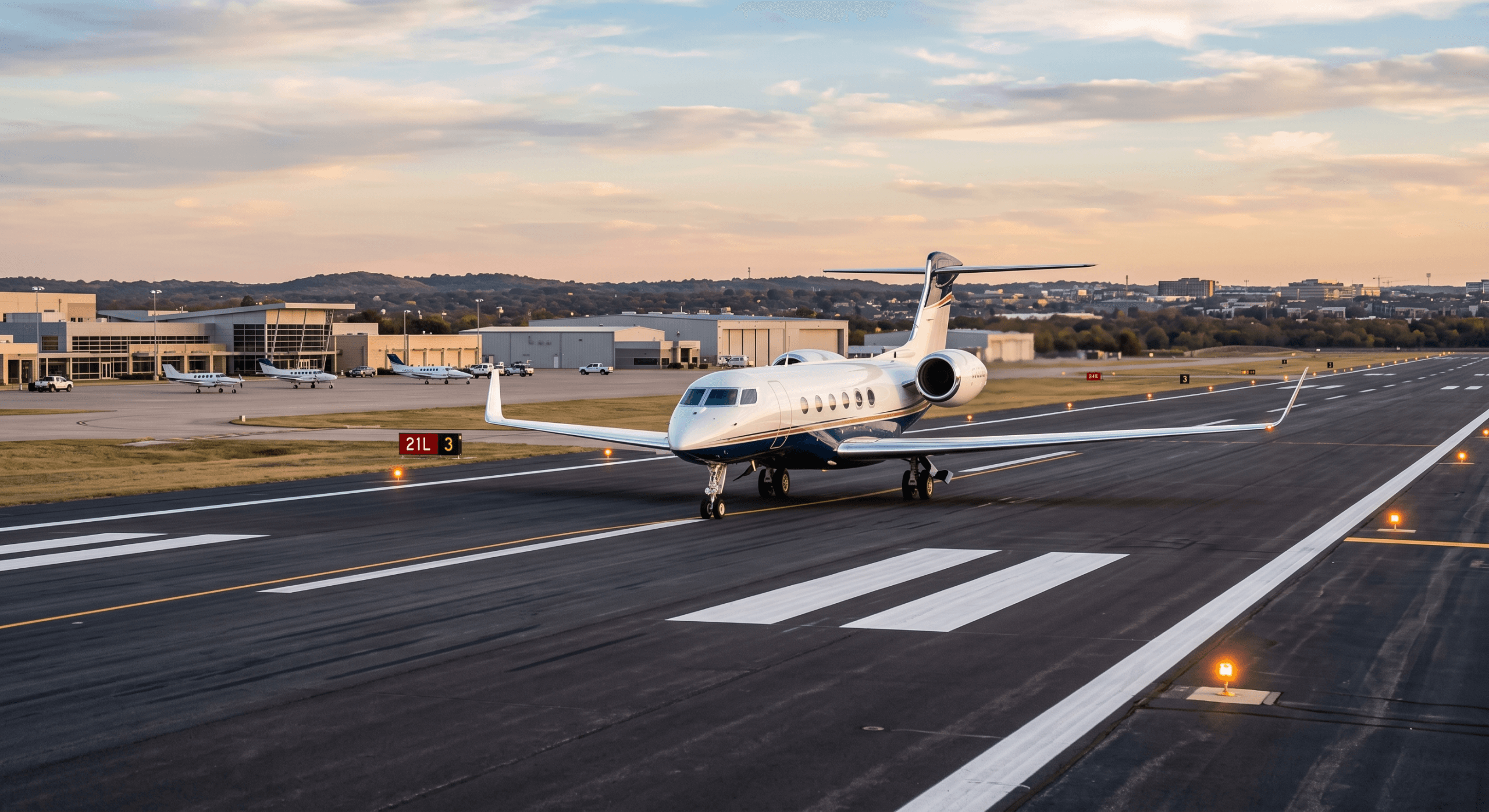
What Is an FBO? Your Guide to Private Jet Terminals
What FBO stands for and what it means
FBO stands for Fixed Base Operator. It is the ground-service company that operates private aviation facilities at an airport, and the physical terminal building itself is commonly called “the FBO.” When you book a private jet charter through SkyAccess, your aircraft departs from and arrives at an FBO, not the commercial airline terminal.
Every airport with significant private jet traffic has at least one FBO. Major private aviation hubs often have several competing FBOs. At Teterboro Airport (TEB), which serves the New York metro area for private aviation, there are two primary FBOs on opposite sides of the field. At Van Nuys Airport (VNY), which handles much of the Los Angeles private jet traffic, there are multiple options. At smaller regional airports, there may be just one FBO managing all private aviation.
The National Business Aviation Association (NBAA) publishes standards and resources for FBO operations that outline the services these facilities provide across the US.
What happens at an FBO
The FBO experience is fundamentally different from a commercial terminal. When you book a private jet through SkyAccess, here is what the FBO process typically looks like:
Arrival at the FBO
You drive directly to the FBO building, not the commercial departure terminal. FBOs typically have their own parking lot or valet service. Many have covered vehicle drop-off areas directly adjacent to the ramp. If you are arriving by car service, the driver brings you to the FBO entrance, not a curbside departure zone shared with commercial passengers.
At the FBO desk, you give your name and flight number. Staff confirm your booking and direct you to the lounge. At no point do you go through a commercial TSA checkpoint. Private flights operate under a separate federal security framework; the FBO staff and your operator handle the pre-departure verification.
The FBO lounge
FBO lounges range from functional waiting rooms at smaller regional airports to full-service facilities at major private aviation hubs. A well-appointed FBO lounge typically includes:
- Complimentary refreshments (coffee, water, often snacks or light catering)
- Private meeting rooms or quiet working areas
- Wi-Fi
- Concierge services (ground transportation, catering orders, hotel bookings)
- Pilot and crew briefing areas separate from the passenger lounge
- Shower facilities at larger FBOs (useful for long-haul arrivals)
You do not wait in a queue at a gate. You wait in the lounge until your aircraft is ready, at which point a staff member walks you across the ramp to your aircraft. The entire process from car to aircraft seat typically takes five to ten minutes.
Ramp access and boarding
The ramp is the paved area where aircraft park. When your jet is ready, FBO staff escort you directly from the lounge across the ramp to the airstairs. You walk outside briefly, board, and the aircraft departs. On arrival, the process runs in reverse: the aircraft parks, you deplane directly onto the ramp, and FBO staff bring you inside while your bags are offloaded.
Private jet passengers almost never interact with TSA screening in the commercial sense. Customs and immigration at international arrivals work differently: many FBOs at international or international-capable airports have a designated US Customs and Border Protection (CBP) arrival facility on-site. You clear customs at the FBO, not in the commercial terminal.
FBO services beyond passenger handling
FBOs do more than handle passengers. They are the ground-service infrastructure for the entire private aviation ecosystem at a given airport. Key services include:
Fuel and fueling
FBOs sell aviation fuel (Jet-A for turbine aircraft) and handle all aircraft fueling. Fuel pricing varies by FBO, which is why operators often choose specific FBOs at airports that have several options. Fuel is typically the largest single variable cost for an operator on a flight, so FBO fuel pricing directly affects charter rates.
Aircraft parking and hangar storage
FBOs manage ramp space and hangar storage for based aircraft (aircraft permanently stationed at the airport) and transient aircraft (those visiting for a specific flight). Hangar fees and ramp fees are part of the operator’s cost structure and ultimately reflected in charter pricing.
Catering coordination
Most FBOs coordinate with local catering vendors to provision aircraft cabins with food and beverages ordered by operators or passengers. If you want a specific meal or dietary accommodation on your private jet, you or your operator typically places the order through the FBO before departure.
Ground transportation
FBO concierge desks can arrange ground transportation, including cars, SUVs, and helicopters for onward transfers. At private aviation hubs near high-demand destinations (Aspen, Nantucket, the Hamptons), the FBO often serves as a coordination point for helicopter transfers when road access is slow or impractical.
FBO vs. commercial terminal: the key differences
The practical differences between arriving at an FBO and using a commercial terminal are significant enough that experienced private travelers often describe them in binary terms:
- Time: FBO arrival-to-airborne is typically 10 to 20 minutes. Commercial terminal processes routinely take 60 to 120 minutes or more.
- Security screening: FBOs do not route passengers through commercial TSA screening lanes. Access protocols apply, but there is no shoe removal, no belt removal, no full-body scanner queue.
- Crowds: FBO lounges handle a fraction of the passenger volume of commercial terminals. Crowding, noise, and wait times are minimized by design.
- Flexibility: commercial flights leave on schedule; private jets wait for you within reason (most operators allow 15 to 30 minutes flexibility for delayed passengers). The FBO holds your aircraft, not the other way around.
- Parking: FBOs have parking. Commercial terminal parking at major airports can mean a 20-minute shuttle to the terminal before you even enter the building.
Which airports have the best FBOs for private jet travelers?
The best FBOs for private jet passengers in the US are generally at dedicated private aviation airports or the private aviation sections of major commercial airports. High-volume private aviation FBOs include:
- Teterboro Airport (TEB), New Jersey, serving the New York metro area
- Van Nuys Airport (VNY), serving Los Angeles
- Scottsdale Airport (SDL), serving the Phoenix metro and Arizona golf season
- Westchester County Airport (HPN), serving Westchester and Connecticut
- Opa-locka Executive Airport (OPF), serving Miami
- Chicago Executive Airport (PWK), serving Chicago’s North Shore
- Centennial Airport (APA), serving Denver and Colorado ski destinations
At international hubs like JFK, LAX, and ORD, dedicated private FBO terminals (Signature, Jet Aviation, Sheltair, and others) provide comparable service within or adjacent to the main airport perimeter.
How FBOs relate to empty leg flights
When a charter operator completes a one-way flight and the aircraft needs to reposition for the next booking, it departs from the destination FBO empty. That repositioning leg is what becomes an empty leg flight listed on SkyAccess. The operator uses the FBO at both the departure and arrival airports for the same ground services, and the passenger experience at the FBO is identical whether you are on a full-charter flight or an empty leg.
SkyAccess displays the departure and arrival FBO (or airport) on every empty leg listing, so you can see exactly which terminal you are departing from before you book. On platforms like SkyAccess, 5,000+ live empty legs are available at any given time, saving travelers 25 to 75% compared to full-charter rates on the same aircraft and route, using the same FBO infrastructure.
Find your next private flightBrowse live empty legs and full-charter options departing from FBOs across the US and internationally. All-in pricing, no membership required.
Frequently asked questions
Do I need to go through security at an FBO?
Not in the commercial TSA sense. FBOs have access controls and identity verification, but passengers do not pass through TSA screening lanes, remove shoes or belts, or wait in scanner queues. International arrivals require customs clearance, often at the FBO itself for airports with CBP facilities.
How early should I arrive at an FBO?
For domestic flights, 15 to 30 minutes before departure is standard for most operators. For international departures, 45 to 60 minutes is typical to allow for customs paperwork and any pre-departure formalities. Your operator or SkyAccess will provide specific guidance with your booking confirmation.
Can I bring guests to the FBO lounge?
Policies vary by FBO. Many allow non-flying guests into the public areas of the lounge for send-offs or arrivals. Some restrict ramp access to passengers and crew. Ask the FBO when you arrive.
Is parking free at FBOs?
Parking policies vary. Some FBOs offer complimentary parking for private jet passengers; others charge daily rates. Valet service is common at larger FBOs. Check with your FBO directly or ask your operator when you confirm your booking details.
Related reading
Liked this post? Share with others!