Light Jet vs. Midsize Jet: Which Private Jet Is Right for Your Trip?
How to choose the right private jet category
The most common question first-time private jet bookers ask is whether to go with a light jet or a midsize jet. The honest answer is that neither category is universally better. The right choice depends on four variables: route distance, passenger count, baggage volume, and cabin comfort expectations. Get those four inputs right and the aircraft decision becomes straightforward.
Light jets and midsize jets together make up the majority of charter flights booked on SkyAccess. Understanding the real-world differences, not just the spec-sheet numbers, saves you money and prevents the unpleasant surprise of arriving at the FBO with too much luggage or too many passengers.
What is a light jet?
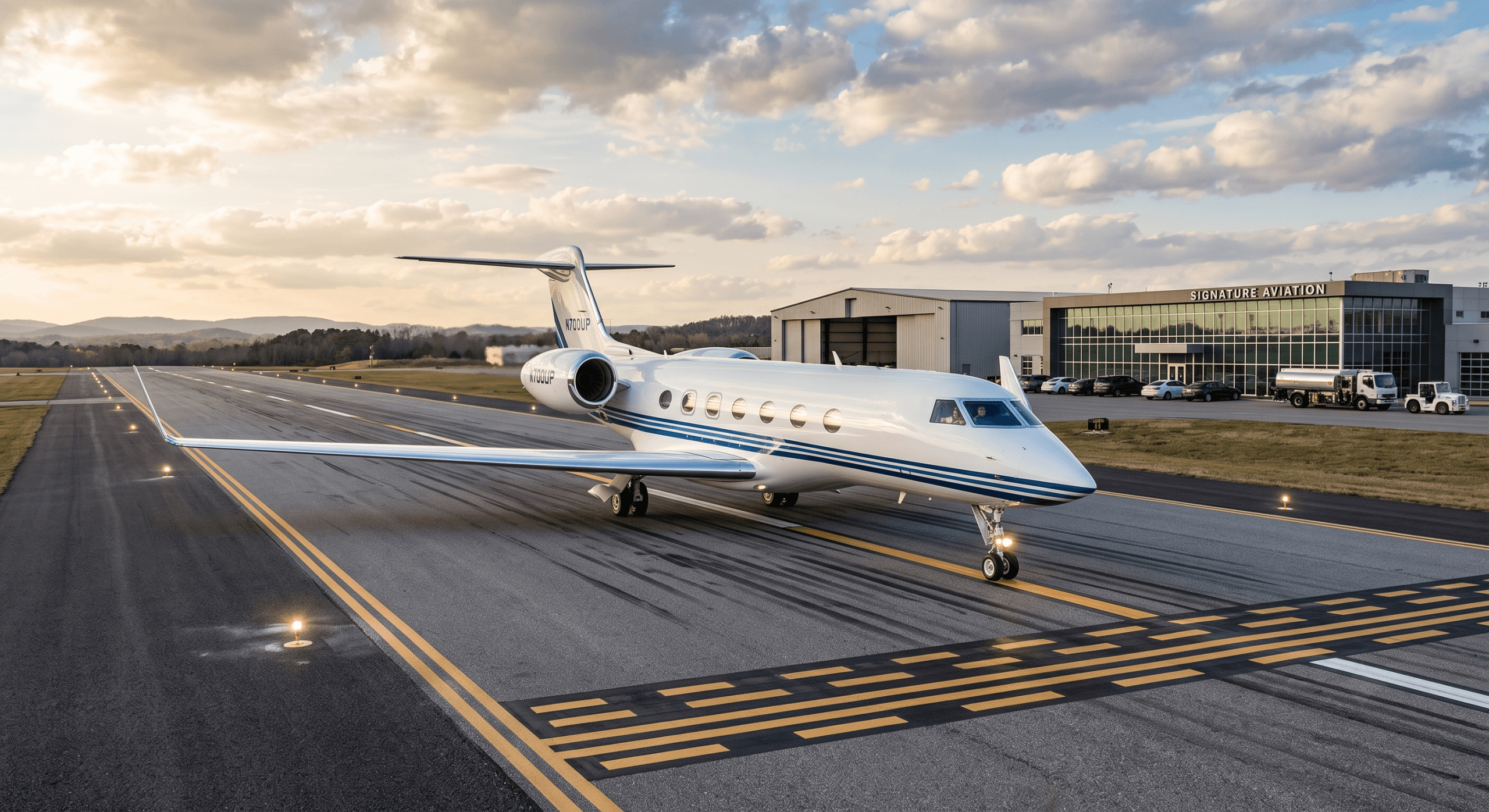
A light jet is a turbofan aircraft seating four to eight passengers, with a cabin that is typically 4.5 to 5.5 feet wide and 4 to 5 feet tall. Most passengers in a light jet cabin sit upright but cannot stand fully. These aircraft are certified to fly at cruise altitudes of 41,000 to 45,000 feet, which lets them route above commercial air traffic and turbulence on shorter segments.
Common light jet models include the Cessna Citation CJ3, the Embraer Phenom 300, and the Pilatus PC-24. Full-charter rates typically run $2,000 to $6,000 per flight hour depending on aircraft age, operator, and market. On empty leg flights, the same aircraft commonly books for 25 to 75% less than the full-charter rate.
Light jets are optimized for trips under three hours. On routes like New York to Boston, Chicago to Detroit, or Los Angeles to Las Vegas, a light jet is often the most cost-efficient option in the private jet category.
Light jet range and limitations
Most light jets have a maximum range of 1,500 to 2,200 nautical miles. In practice, when you factor in full passenger loads, luggage weight, and fuel reserves, the effective range drops. A Phenom 300 carrying six passengers and baggage typically completes nonstop flights up to about 1,700 nautical miles reliably. Anything beyond that, or anything crossing mountain airports with high field elevations, may require a fuel stop.
Baggage capacity is the other constraint. Light jets carry approximately 60 to 85 cubic feet of external luggage space, which translates to roughly two medium bags per passenger before the cabin gets tight. If your group is traveling with golf clubs, ski equipment, or oversized gear, a light jet will either not work or will require leaving bags behind.
What is a midsize jet?
A midsize jet seats seven to ten passengers in a cabin that is usually 5.5 to 6.5 feet wide and tall enough for most adults to stand. The wider cabin means club seating configurations, a real lavatory (enclosed, not a curtained closet), and more usable working space. These aircraft also carry significantly more baggage, typically 100 to 140 cubic feet of external luggage capacity.
Common midsize models include the Citation XLS+, the Hawker 800XP, the Learjet 60XR, and the Embraer Legacy 450. Full-charter rates run $4,000 to $8,000 per flight hour. Empty leg rates on SkyAccess frequently bring that hourly cost down into the range competitive with commercial first class on a per-person basis when the aircraft is full.
Midsize jet range and strengths
Midsize jets typically achieve 2,500 to 3,500 nautical miles of range, which makes nonstop coast-to-coast US flights (New York to Los Angeles is about 2,451 nautical miles) realistic with a light passenger load. Newer super-midsize variants like the Challenger 350 and Citation Longitude push that range to 3,200 to 3,500 nautical miles nonstop and add flat-floor options.
For business travel specifically, the midsize cabin is meaningfully better for productivity. The wider seats and tables allow comfortable laptop use, the enclosed lavatory adds privacy, and the quieter cabin at cruise altitude (midsize jets tend to run 2 to 5 decibels quieter than comparable light jets) reduces fatigue on longer legs.
Direct comparison: light jet vs. midsize jet
Passenger capacity
Light jets: four to eight passengers. Midsize jets: seven to ten. For groups of four or fewer, a light jet is almost always the right choice on routes under 2,000 nautical miles. For groups of seven or more, a midsize jet is required.
The overlap zone is five to seven passengers. A light jet can technically carry six people, but if any of those six are tall adults or if the flight is over 90 minutes, the cramped cabin becomes a real comfort issue. SkyAccess operators consistently flag that groups of six traveling two or more hours are substantially happier on a midsize aircraft, even at the higher cost.
Baggage and cargo
Light jet: plan for one carry-on-sized and one medium bag per person as the practical limit. Midsize jet: two checked-bag-sized pieces per person is achievable. If your group includes golf clubs, ski gear, large musical instruments, or significant business equipment, do the luggage math before booking. A single set of golf clubs in a travel bag is roughly 8 to 10 cubic feet. Four sets of clubs on a light jet with four passengers will leave essentially no room for personal bags.
Cabin comfort
For short hops (under 60 to 90 minutes), the comfort difference is minimal. For flights of two hours or more, the standing headroom, enclosed lavatory, and seat width of a midsize jet make a meaningful difference, particularly for business travelers who want to work rather than rest.
For anything over three hours, consider stepping up to a super-midsize or heavy jet. Both light and standard midsize jets become fatiguing on cross-country or transatlantic segments.
Cost
A light jet on a two-hour route will typically cost $4,000 to $12,000 for the full aircraft. A midsize jet on the same route runs $8,000 to $16,000. The spread narrows on empty legs: the platform regularly lists light jet empty leg flights under $3,000 and midsize empty legs under $6,000 on competitive routes.
When a group of six splits the cost of a midsize jet versus a light jet, the per-person difference on a two-hour flight is often under $500. At that margin, most groups prefer the better cabin.
When to book a light jet
- Group of four or fewer passengers
- Route under 1,800 nautical miles without a fuel stop
- Light baggage (one bag per person)
- Budget-sensitive booking where comfort is secondary to cost
- Short sectors of under 90 minutes where cabin comfort matters less
When to book a midsize jet
- Group of five or more passengers
- Route of 1,800 to 3,000 nautical miles nonstop
- Baggage-heavy travel (golf, ski, business equipment)
- Business travel where in-flight productivity is a priority
- Flight duration of two hours or more where cabin comfort and an enclosed lavatory matter
Finding light and midsize empty legs on SkyAccess
The marketplace lists 5,000+ live empty legs at any given time, with real-time availability from 900+ certified charter operators globally. The search interface lets you filter by aircraft category, so you can compare light jet and midsize jet availability on the same route side by side.
Empty legs typically book 48 to 72 hours before departure, though some appear up to 14 days out. If your schedule has flexibility, both light and midsize empty legs represent the most cost-efficient way to fly privately. According to marketplace data, empty legs on SkyAccess save travelers 25 to 75% compared to full-charter pricing for the same aircraft and route.
Pricing is all-in: no hidden fees, no broker surcharges, no membership required. Browse current light jet and midsize empty legs at the empty leg listings.
Search live empty leg flights nowLight jets and midsize jets available on hundreds of routes today. All-in pricing, no membership required.
Frequently asked questions
Can a light jet fly coast to coast?
Some can, but most will require a fuel stop. The New York to Los Angeles route is approximately 2,450 nautical miles. Most standard light jets max out at 1,700 to 2,000 nautical miles with a full passenger and baggage load. The Phenom 300E has a published range of 2,010 nautical miles but rarely completes the NY to LA segment nonstop at maximum payload. If nonstop coast-to-coast is a requirement, a super-midsize or heavy jet is the more reliable choice.
Which aircraft is quieter?
Midsize jets are generally quieter at cruise altitude. Light jets, particularly older models, tend to have higher cabin noise levels because the engines are mounted closer to the cabin. Newer light jets like the Phenom 300 have improved significantly, but the gap to midsize aircraft remains.
Do light jets have bathrooms?
Most light jets include a lavatory, but it is typically a small, uncurtained or lightly curtained area at the rear of the cabin rather than an enclosed room. Midsize jets typically have an enclosed lavatory with a door. For flights over two hours with mixed-gender groups or business travelers, the enclosed lavatory on a midsize jet is a meaningful upgrade.
Is it cheaper to fly light jet empty legs than commercial first class?
On a per-person basis for groups of four or more, yes. A light jet empty leg on SkyAccess for a two-hour route at $3,500 total costs $875 per person for four passengers, which is competitive with or below first-class fares on many US domestic routes, without the airport security lines, fixed departure times, or shared cabin.
Related reading
Liked this post? Share with others!